In today’s industrial environment, maintaining clean air is essential for ensuring worker safety, protecting machinery, and meeting environmental regulations. Whether you operate in metal fabrication, pharmaceuticals, food processing, woodworking, or cement production, selecting the right Dust Collector Manufacturer directly impacts your operational efficiency and long-term costs. A reliable manufacturer doesn’t simply provide equipment—they deliver engineered solutions that improve workplace safety, minimize downtime, and ensure compliance with industry standards.
With numerous suppliers offering different technologies and capabilities, making the right choice requires careful evaluation. This guide explains the key factors you should consider before investing in an industrial dust collection solution.

Why Choosing the Right Dust Collector Manufacturer Matters
A high-quality dust collection system does much more than remove airborne particles. It protects employees from hazardous dust exposure, improves product quality, extends equipment life, and reduces maintenance requirements. Choosing the wrong manufacturer may result in poor filtration efficiency, excessive energy consumption, frequent breakdowns, and expensive repairs.
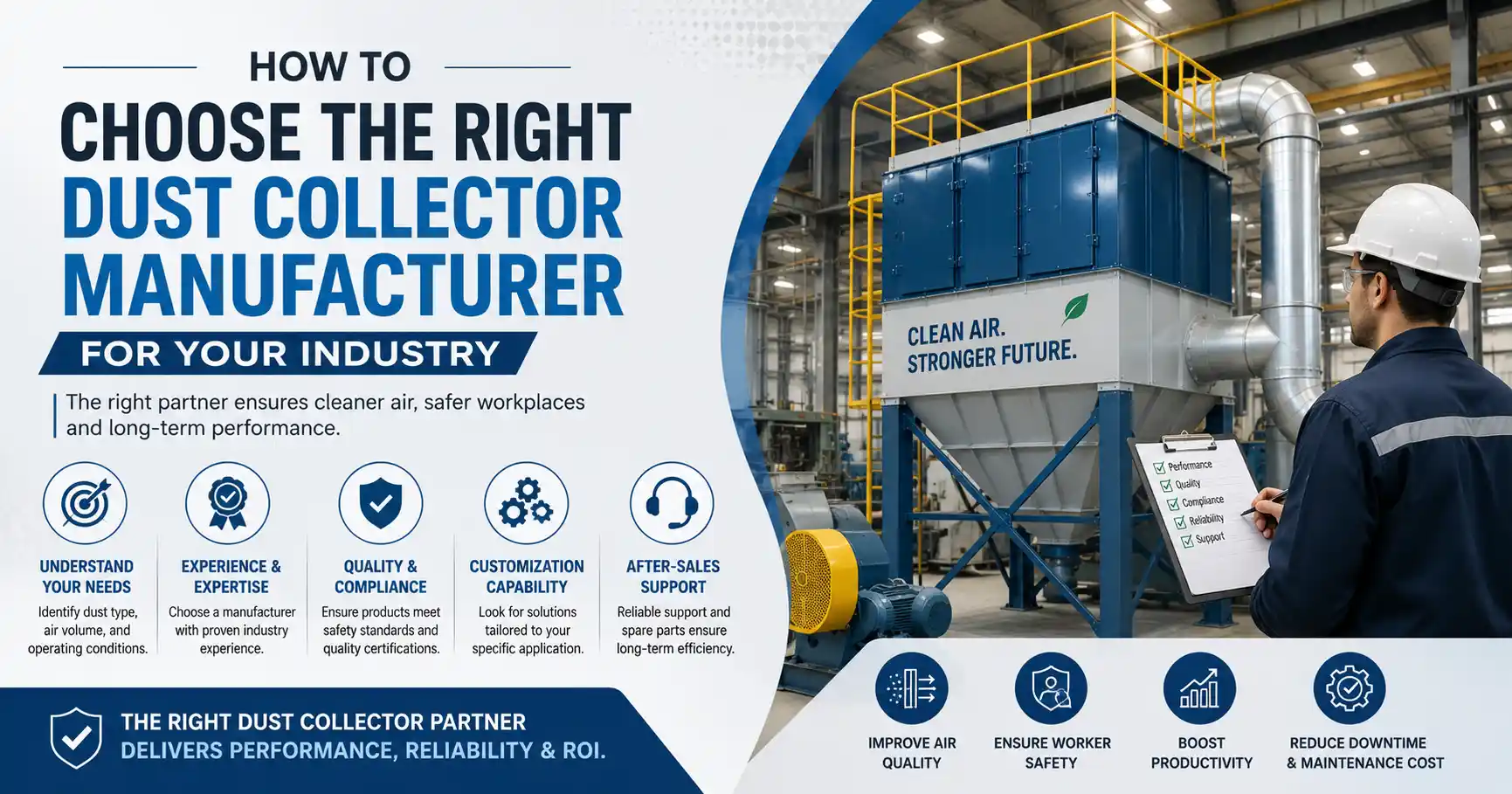
When evaluating a Dust Collector Manufacturer, look beyond pricing. Consider engineering expertise, product reliability, after-sales support, customization capabilities, and compliance with industrial safety standards. The right partner will understand your production process and recommend a solution that fits your operational needs rather than offering a generic product.
How to Choose a Dust Collector Manufacturer: Key Evaluation Factors
If you’re wondering How to Choose a Dust Collector Manufacturer, start by understanding your own industrial requirements before comparing manufacturers.
Understand Your Industry Requirements
Every manufacturing process generates different types of dust. Fine pharmaceutical powders require different filtration technology than metal grinding dust or wood chips.
Evaluate:
- Dust particle size
- Dust volume generated
- Airflow requirements
- Temperature and humidity conditions
- Combustible dust risks
- Local environmental regulations
These factors determine the design and capacity of the dust collection system you need.
Evaluate Engineering Expertise
Experienced manufacturers analyze your production process before recommending equipment. Their engineering team should perform airflow calculations, filtration analysis, duct layout planning, and system sizing to maximize efficiency.
A knowledgeable manufacturer also understands industry-specific challenges and recommends solutions that reduce operational costs while improving air quality.
Check Product Quality and Manufacturing Standards
Reliable equipment delivers consistent performance for years. Evaluate the manufacturer’s:
- Filter media quality
- Fan efficiency
- Steel construction
- Corrosion-resistant coatings
- Welding quality
- Testing procedures
High-quality construction ensures lower maintenance costs and longer equipment life.
Industrial Dust Collection Systems: Features That Matter
Modern Industrial Dust Collection Systems are designed to maximize filtration efficiency while minimizing energy consumption. Rather than selecting equipment based only on airflow capacity, evaluate the complete system.
Important features include:
- High-efficiency cartridge or bag filters
- Variable frequency drive (VFD) compatibility
- Automatic pulse jet cleaning
- Energy-efficient fan design
- PLC-based control systems
- Easy filter replacement
- Low maintenance requirements
Advanced monitoring systems also allow operators to track pressure drop, airflow, and filter condition, helping prevent unexpected downtime.
Well-designed Industrial Dust Collection Systems improve production efficiency while supporting workplace safety and regulatory compliance.
Compare the Experience of Every Dust Collection Equipment Manufacturer
Every Dust Collection Equipment Manufacturer has different strengths. Some specialize in standard equipment, while others provide customized engineering solutions for complex industrial applications.
Ask questions such as:
- How many years have they served your industry?
- Can they provide case studies?
- Do they manufacture in-house?
- What certifications do they maintain?
- What warranty do they offer?
- How responsive is their technical support?
An experienced Dust Collection Equipment Manufacturer should confidently explain how their systems solve industry-specific challenges instead of focusing only on product specifications.
Evaluate Customization Capabilities
No two manufacturing facilities are exactly alike. Factors such as plant layout, available installation space, production capacity, and future expansion plans often require customized designs.
A manufacturer capable of customization can provide:
- Tailored ducting layouts
- Modular system expansion
- Specialized filtration media
- Explosion protection options
- Noise reduction solutions
- Integrated control systems
Customization improves overall system efficiency and ensures optimal performance throughout the equipment’s lifecycle.
Assess Industrial Dust Collector Suppliers Beyond Pricing
Price should never be the only deciding factor when comparing Industrial Dust Collector Suppliers. Lower-cost equipment may lead to higher maintenance expenses, increased energy consumption, and shorter equipment lifespan.
Instead, evaluate the total cost of ownership, including installation, maintenance, spare parts availability, energy efficiency, and technical support.
Reliable Industrial Dust Collector Suppliers provide transparent documentation, responsive customer service, readily available replacement parts, and comprehensive maintenance guidance that keeps your production running smoothly.
Compliance and Safety Standards
Industrial dust collection equipment should comply with applicable workplace safety and environmental regulations. Depending on your industry, this may include standards related to air quality, combustible dust handling, emissions control, and worker safety.
Manufacturers should provide documentation for filtration efficiency, equipment testing, and system performance. Certifications demonstrate a commitment to quality and regulatory compliance, giving buyers greater confidence in long-term reliability.
Explore More: Dust catcher machines | Hydroseeder Machine in Tamil Nadu | Automatic car washing machine
Installation and After-Sales Support
Even the best equipment performs poorly if installation is incorrect. Professional manufacturers provide installation guidance, commissioning support, operator training, and preventive maintenance services.
Strong after-sales support should include:
- Technical troubleshooting
- Spare parts availability
- Maintenance recommendations
- Remote assistance
- Periodic inspections
- System performance optimization
Responsive support minimizes production interruptions and extends equipment lifespan.
Choosing the Best Dust Collector for Manufacturing Industry
Selecting the Best Dust Collector for Manufacturing Industry depends on your specific production process rather than choosing the largest or most expensive system.
Consider the following factors before making your decision:
- Production capacity
- Dust characteristics
- Filtration efficiency
- Energy consumption
- Available floor space
- Maintenance accessibility
- Future production expansion
The Best Dust Collector for Manufacturing Industry is one that balances filtration performance, operational efficiency, safety compliance, and long-term operating costs while meeting your plant’s unique requirements.
Conclusion
Choosing the right Dust Collector Manufacturer is a strategic investment that affects workplace safety, production efficiency, equipment reliability, and regulatory compliance. Rather than focusing only on initial purchase price, evaluate engineering expertise, customization capabilities, manufacturing quality, after-sales service, and long-term value.
By carefully comparing manufacturers and understanding your facility’s specific dust control requirements, you can invest in a solution that delivers reliable performance for years. Companies like Automeck demonstrate how experienced manufacturers combine engineering knowledge with customized solutions to help industries achieve cleaner, safer, and more productive manufacturing environments.
Frequently Asked Questions
1. Why is choosing the right dust collector manufacturer important?
A reliable manufacturer provides efficient systems, long-term performance, quality support, and compliance with industrial safety standards.
2. What factors should I consider before buying a dust collector?
Consider dust type, airflow requirements, filtration efficiency, energy consumption, maintenance needs, and manufacturer expertise.
3. Which industries need industrial dust collection systems?
Industries such as woodworking, pharmaceuticals, cement, food processing, metal fabrication, chemicals, and mining commonly require dust collection systems.
4. How often should industrial dust collectors be maintained?
Routine inspections should be performed regularly, while filter replacement and preventive maintenance depend on operating conditions and manufacturer recommendations.
5. Can a dust collector be customized for my facility?
Yes. Many manufacturers offer customized ducting, filtration options, airflow design, control systems, and modular configurations to match specific industrial requirements.