Air pollution caused by dust is a common challenge in industries such as mining, construction, cement manufacturing, material handling, and waste processing. Dust generated during crushing, grinding, loading, and transportation can remain suspended in the air, affecting workplace conditions and the surrounding environment. A dust suppression system helps control these particles at their source, reducing the amount of airborne dust and improving overall air quality. By using water mist, specialised sprays, foam, or other suitable technologies, businesses can minimise dust emissions, protect workers, and maintain cleaner industrial facilities. Understanding how these systems work can help organisations choose effective solutions for their operational needs.

What Is a Dust Suppression System?
A dust suppression system is an arrangement of equipment and technologies designed to prevent dust from becoming airborne or to remove suspended particles from the air. Depending on the application, it may use water droplets, fine mist, foam, or chemical dust suppressants to control particulate matter.
Dust is commonly generated when materials are crushed, transferred, drilled, excavated, or moved across dry surfaces. Fine particles can travel beyond the immediate work area, reducing visibility and potentially affecting respiratory health.
Unlike systems that primarily capture dust through extraction and filtration, suppression technologies often prevent particles from dispersing in the first place. The appropriate approach depends on the material, particle size, moisture sensitivity, environmental conditions, and production requirements.
When designed correctly, a dust suppression system can become an important part of an organisation’s environmental management and workplace safety strategy.
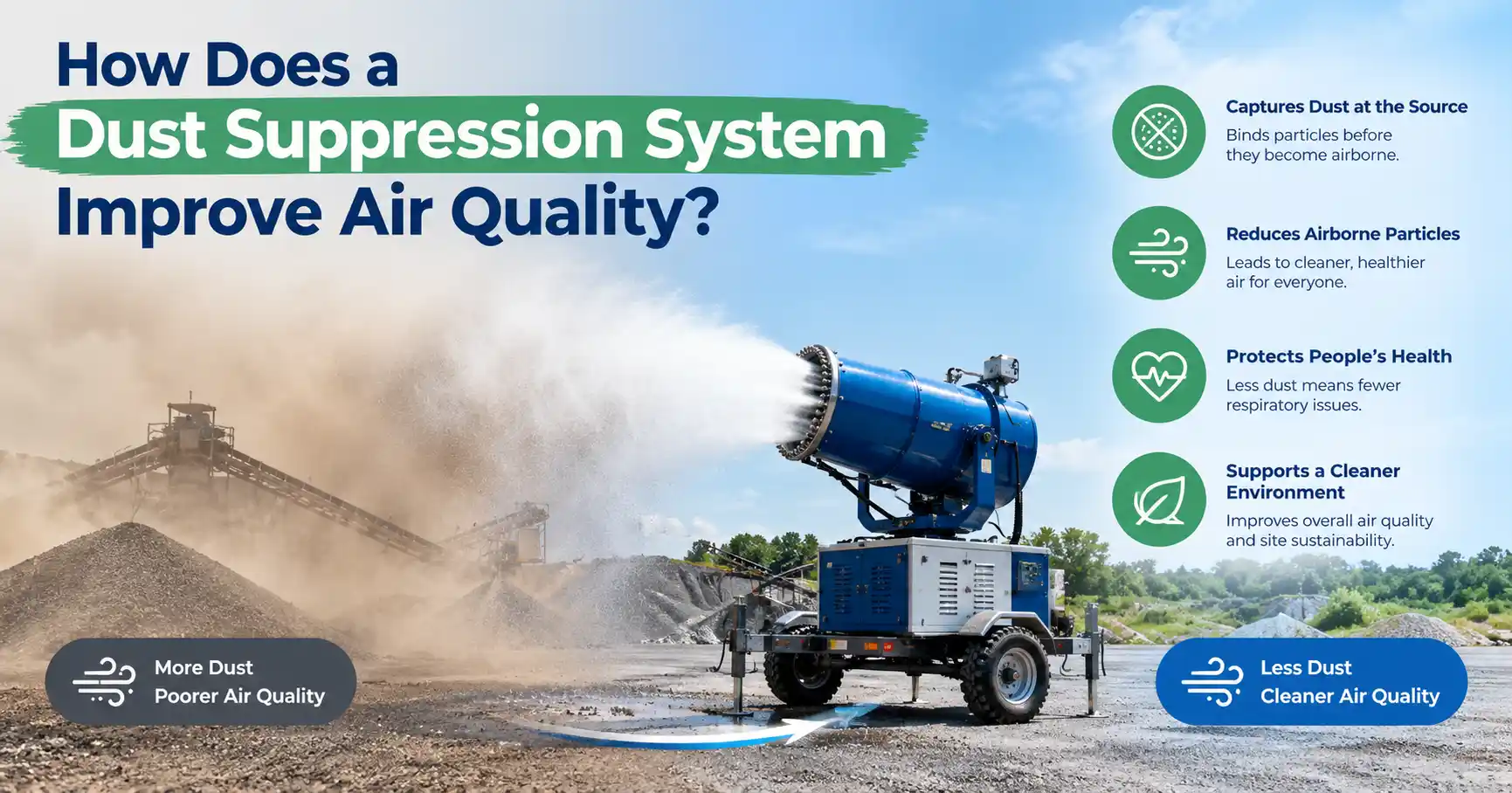
How Does a Dust Suppression System Improve Air Quality?
The main purpose of dust suppression is to reduce the concentration of airborne particles before they spread across a facility or escape into the surrounding environment. The process works through several mechanisms.
1. Captures Dust Particles at the Source
Water sprays and mist systems introduce droplets into dust-generating areas. When droplets collide with airborne particles, they can combine and form heavier agglomerates that settle more readily under gravity.
This process is particularly useful around conveyor transfer points, crushers, stockpiles, loading areas, and material discharge zones.
Controlling dust close to its source is generally more effective than allowing it to spread throughout a facility before taking action.
2. Reduces Suspended Particulate Matter
Fine dust, including particulate matter such as PM10 and PM2.5, can affect air quality. PM10 refers to particles with aerodynamic diameters of 10 micrometres or less, while PM2.5 refers to particles measuring 2.5 micrometres or less.
The effectiveness of a suppression system depends on droplet size, particle characteristics, airflow, and the technology being used. Properly designed mist systems can help control certain fine particles, although no single approach is equally effective for every dust type.
A dust suppression system for air quality can therefore contribute to lower airborne dust concentrations when it is selected, installed, and maintained according to the site’s requirements.
3. Prevents Dust from Spreading Across the Site
Dust generated in one section of a factory or construction site can move into nearby workspaces, offices, storage areas, and public spaces. Wind, vehicle movement, ventilation, and material handling can increase its spread.
Targeted sprays, enclosure systems, and surface wetting help reduce dust migration. In outdoor environments, appropriate spray placement and wind conditions are especially important.
Reducing dust movement improves visibility, helps keep equipment and surfaces cleaner, and supports better housekeeping throughout the site.
4. Supports Worker Health and Safety
Repeated exposure to certain types of industrial dust can contribute to respiratory problems and other health effects. The level of risk depends on particle size, composition, concentration, and exposure duration.
For example, respirable crystalline silica generated during cutting, drilling, or processing certain construction materials requires particularly careful control.
A dust suppression system can reduce exposure when integrated into a broader occupational safety programme. However, suppression alone may not be sufficient for hazardous dust. Local exhaust ventilation, suitable respiratory protection, exposure monitoring, and other controls may also be necessary.
Common Dust Suppression Methods Used in Industries
Different industries produce different types of dust, so the right technology depends on the source and operating conditions. Understanding the available dust suppression methods helps businesses select an approach that balances effectiveness, water consumption, maintenance, and production needs.
Water Spray Systems
Water spray systems use nozzles to apply controlled amounts of water to dusty materials or emission points. They are widely used in quarries, construction projects, cement plants, and material handling operations.
These systems are relatively straightforward to operate and can be installed at conveyor belts, crushers, transfer chutes, and stockpiles. Nozzle selection, pressure, and spray direction influence their performance.
Fine Mist and Fogging Systems
Fine mist systems generate small droplets that interact with airborne dust particles. They are useful in applications where dust remains suspended in the air, including some mining, recycling, and bulk material handling environments.
Effective performance requires appropriate droplet sizing and sufficient contact between droplets and particles. Airflow and humidity can also influence results.
Foam-Based Dust Control
Foam systems combine water with a foaming agent to create a layer that helps bind dust to material surfaces. They can be useful for controlling dust in certain crushing and conveying operations, particularly where conventional spraying may require excessive water.
The foam formulation must be compatible with the material and operating process.
Chemical Dust Suppressants
Some operations use approved chemical additives or binding agents to improve moisture retention and reduce dust generation from roads, stockpiles, and exposed surfaces.
These products can be useful in dry environments, but their environmental compatibility, application requirements, and potential effects on equipment or materials must be assessed before use.
Explore More: Hydroseeder machine in delhi | Dust collector manufacturers | Dust Collector Machine in Rajasthan
Where Are Industrial Dust Control Systems Most Useful?
Industrial dust control systems are used wherever handling dry materials creates airborne particles. Their configuration varies according to the process, material characteristics, and required level of control.
In mining and quarrying, dust can develop during drilling, blasting, crushing, screening, and transportation. Targeted suppression helps control emissions at these points.
Construction sites use dust control during demolition, excavation, concrete cutting, and movement of vehicles over unpaved roads. Cement plants and manufacturing facilities may require suppression around silos, conveyor transfer points, and material storage areas.
Waste processing and recycling operations also benefit from controlling dust generated during sorting, shredding, and handling.
A well-planned installation considers the entire material flow rather than focusing on a single dusty location. Combining enclosure, surface wetting, extraction, and housekeeping can deliver better results than relying on one technology alone.
How to Choose the Right Dust Control Solutions
Selecting suitable dust control solutions begins with identifying the source of emissions and understanding the material being processed. A system that works well for coarse mineral dust may not provide adequate control for fine, hazardous particles.
Before investing in equipment, assess the dust’s composition, particle size, moisture sensitivity, and generation rate. Review the site’s ventilation, operating temperature, wind exposure, and water availability.
Water consumption is another important consideration. Excessive moisture can affect material quality, cause blockages, increase corrosion, or create slippery working surfaces. Systems should deliver enough moisture for effective suppression without interfering with production.
Maintenance requirements also matter. Spray nozzles can become blocked, pumps may wear, and filters or water lines may need regular inspection. Automated controls, appropriate filtration, and accessible maintenance points can improve reliability.
For businesses exploring how to reduce airborne dust, the most practical approach is to conduct a site assessment, identify high-emission areas, and select controls based on measurable performance requirements.
A supplier such as Automeck can be considered during the evaluation process, alongside other providers, based on technical suitability, installation support, maintenance requirements, and the specific needs of the operation.
Best Practices for Maintaining Air Quality
Installing equipment is only one part of effective dust management. Regular monitoring and maintenance are essential to ensure that controls continue to perform as expected.
Businesses should inspect nozzles, pumps, pipelines, and control systems to identify leaks, blockages, and changes in spray performance. Water pressure and flow should remain within the equipment manufacturer’s recommended range.
Air quality monitoring can help determine whether dust concentrations are decreasing and whether additional controls are needed. Visual inspections alone cannot reliably measure fine particulate matter or establish that occupational exposure is within acceptable limits.
The following practices can strengthen a dust management programme:
- Inspect suppression equipment regularly and repair damaged or blocked components.
- Monitor airborne dust where appropriate and investigate recurring emission hotspots.
- Combine suppression with enclosure, extraction, ventilation, and good housekeeping where necessary.
- Train employees to operate equipment safely and report dust-control failures.
Organisations should also review applicable environmental regulations and occupational exposure limits. Where hazardous dust is present, controls should be designed around the specific risk rather than relying on general-purpose misting alone.
Conclusion
Clean air is essential for safer workplaces, efficient industrial operations, and responsible environmental management. By controlling dust where it originates, businesses can reduce airborne particles, limit dust migration, and improve visibility around critical work areas.
A properly selected dust suppression system can make a meaningful contribution to these goals when supported by regular maintenance, appropriate monitoring, and complementary safety measures. The key is to understand the dust source, select the right technology, and evaluate performance under actual operating conditions.
With a practical dust management strategy, industries can maintain cleaner facilities while protecting workers and reducing the environmental impact of dust-generating activities.
Frequently Asked Questions
1. What is the main purpose of a dust suppression system?
Its main purpose is to prevent dust from becoming airborne or spreading into surrounding areas.
2. How does dust suppression improve air quality?
It reduces airborne particles by binding dust, increasing particle settling, or limiting dust generation at the source.
3. Which industries need dust suppression systems?
Mining, construction, cement manufacturing, quarrying, recycling, and material handling commonly use them.
4. Are water-based dust suppression systems effective?
Yes, for many applications. Effectiveness depends on particle size, droplet characteristics, application method, and site conditions.
5. How often should dust suppression equipment be maintained?
Inspect it regularly according to operating conditions and manufacturer recommendations, and address blockages or performance issues promptly.