Airflow in a dust collection system is the movement of air through the collection hood, ductwork, filters, and exhaust components to capture and transport airborne dust and particles. A dust collector can have a powerful motor, but that does not automatically mean it will provide effective dust removal. The system must maintain sufficient airflow and velocity at the point where dust is generated.
From woodworking shops and metalworking facilities to cement plants, pharmaceutical manufacturing, food processing, and other industrial environments, dust extraction depends heavily on correctly designed air movement. Understanding airflow helps businesses choose the right collector, duct size, fan capacity, and filtration equipment while avoiding excessive energy consumption.

What Does Airflow Mean in a Dust Collection System?
In simple terms, airflow refers to the volume of air that a dust collection system can move within a specific period. It is commonly measured in cubic feet per minute (CFM). The airflow must be strong enough to capture contaminants at the source and carry them through the ductwork toward the dust collector.
The performance of dust collection system airflow depends on several interconnected components. These include the collection hood, duct diameter, duct length, bends, dampers, filters, fan, and pressure losses throughout the system.
A system with inadequate airflow may allow dust to escape into the workplace even when the collector is operating continuously. On the other hand, unnecessarily high airflow can increase fan energy consumption and operating costs.
This is why airflow should be considered as part of the complete dust extraction system rather than as an isolated specification.
Why Airflow in a Dust Collection System Matters
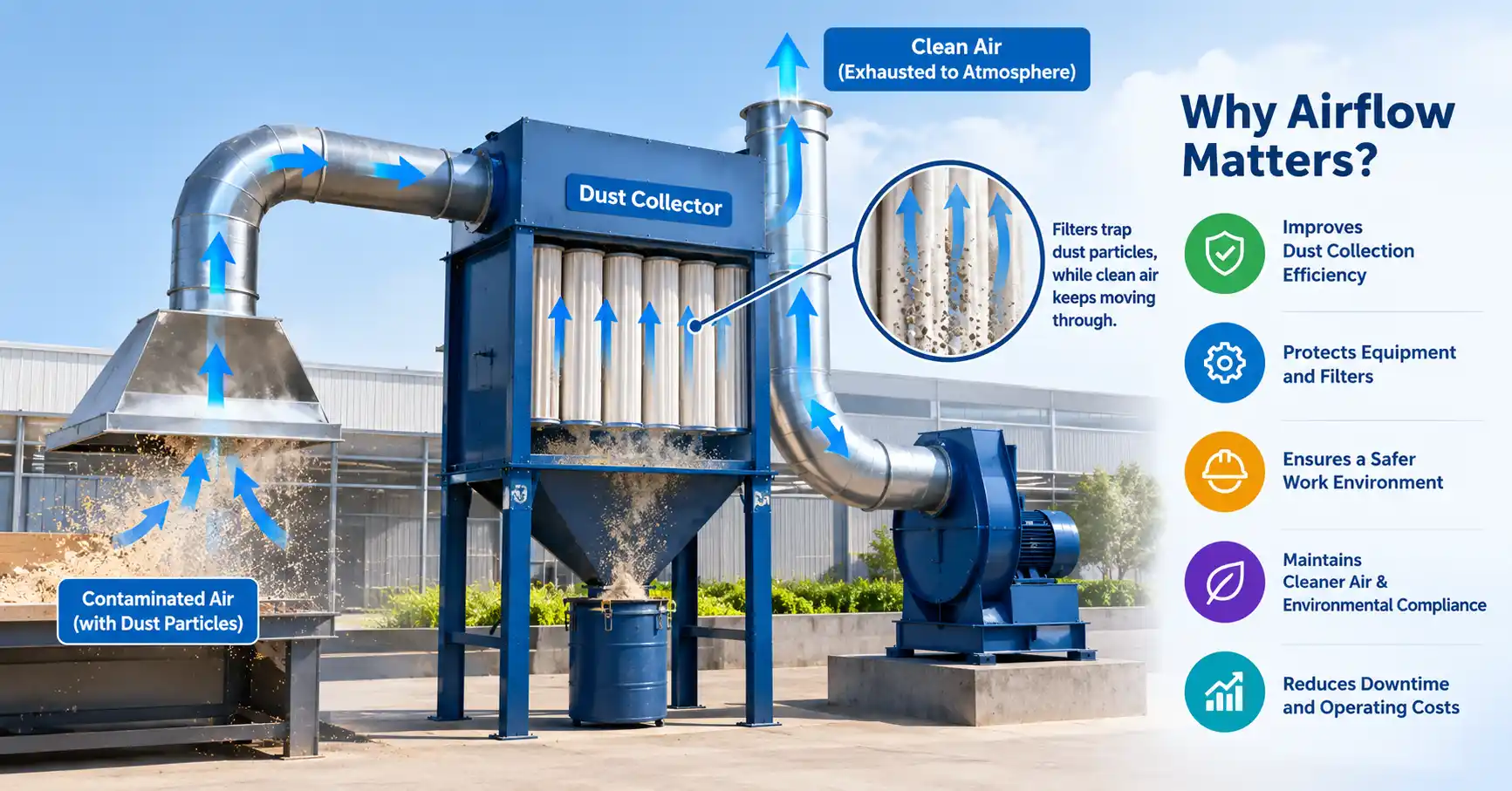
The primary purpose of airflow in a dust collection system is to capture dust before it spreads throughout the working environment. When airflow is properly balanced, particles generated during cutting, grinding, mixing, sanding, drilling, or other processes can be drawn toward the collection point.
Effective airflow also influences the transportation of dust through ducts. The air needs sufficient velocity to prevent collected particles from settling inside the ductwork. If velocity becomes too low, dust can accumulate, restricting the passage and increasing maintenance requirements.
Several factors make airflow important:
- Dust capture: Adequate suction helps capture particles close to their source.
- Duct transport: Correct air velocity keeps dust moving through the duct.
- Filter performance: Appropriate airflow allows filtration equipment to operate within its intended range.
- Workplace cleanliness: Effective extraction reduces airborne dust accumulation.
- Equipment efficiency: A properly designed system avoids unnecessary fan and energy demand.
Therefore, dust collection system airflow should be evaluated alongside static pressure, duct design, filtration efficiency, and the characteristics of the dust being collected.
Understanding Dust Collection System CFM
One of the most important specifications when selecting a dust collector is CFM. Dust collection system CFM represents the volume of air the system moves per minute. However, looking at CFM alone can be misleading.
A fan may be advertised with a high CFM value under conditions where there is little or no resistance. Once the fan is connected to ducts, filters, elbows, hoods, and other components, the actual airflow can be considerably different.
For this reason, system designers consider both airflow and static pressure. Static pressure represents the resistance the fan must overcome while moving air through the system.
The relationship can be understood simply:
Higher system resistance → greater fan pressure requirement → potential reduction in airflow.
When calculating dust collection system CFM, engineers therefore consider the number of collection points, duct dimensions, duct length, fittings, filter resistance, hood design, and required capture velocity.
A correctly selected fan should provide the required airflow at the operating static pressure—not merely the maximum airflow shown on a product specification sheet.
How Dust Collector Airflow Works
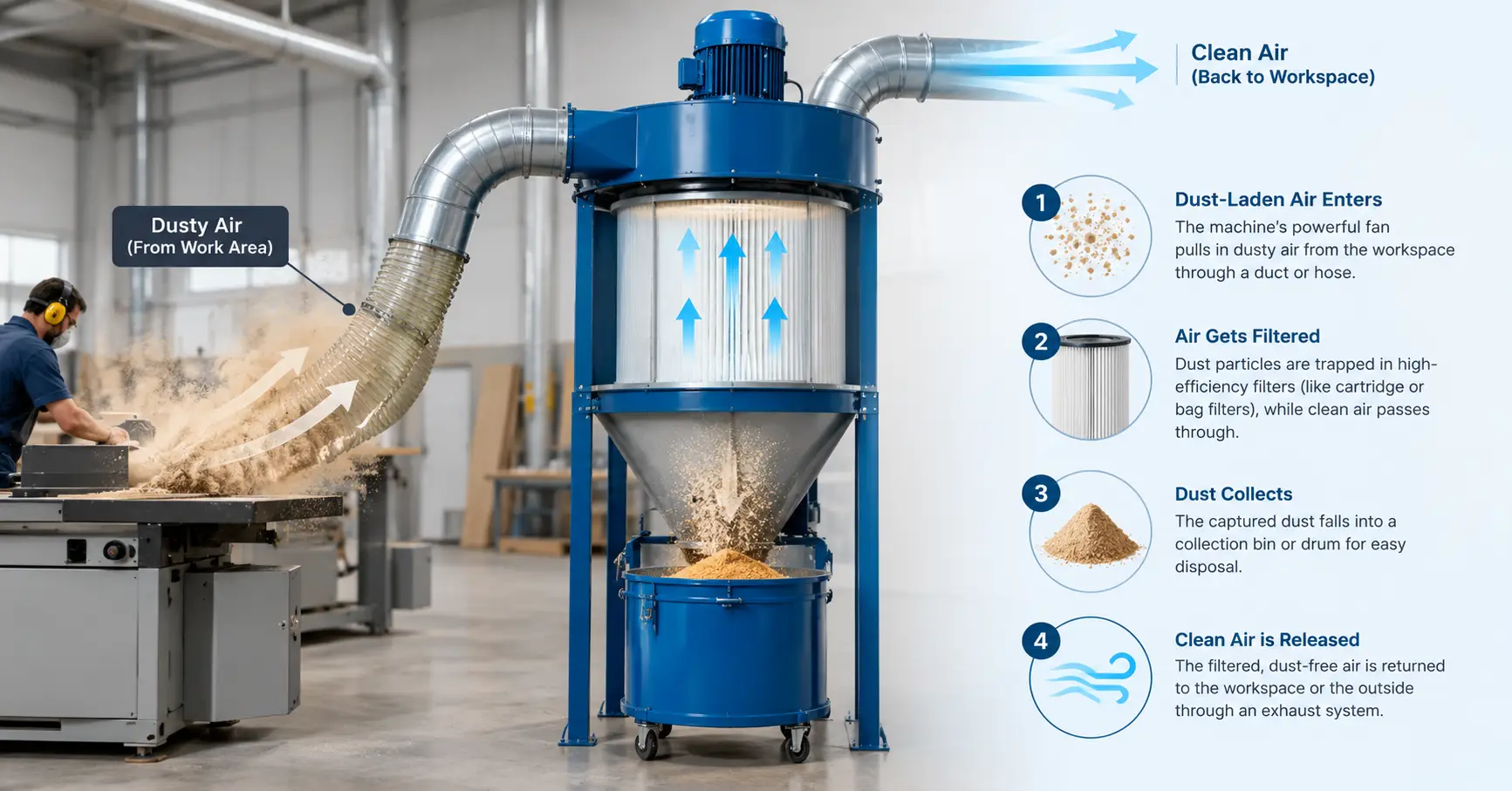
Understanding how dust collector airflow works becomes easier when looking at the complete path followed by contaminated air.
Dust is first generated at a machine or process. A hood or pickup point captures the contaminated air. The air then travels through connected ductwork toward the collector. Inside the dust collector, filters or other separation equipment remove particulate matter from the airstream. Cleaner air is then discharged through the appropriate outlet.
The fan or blower provides the pressure difference that drives this movement.
Several components influence dust collector airflow:
1. Collection hood: Determines how effectively dust is captured at its source.
2. Ductwork: Controls air velocity and contributes to pressure loss.
3. Elbows and fittings: Create additional resistance to airflow.
4. Filters: Remove particles but introduce resistance as they load with dust.
5. Fan or blower: Generates the pressure and air movement needed by the system.
6. Dampers: Help balance airflow between different branches or collection points.
The interaction between these components determines actual operating performance.
For example, installing a larger fan does not necessarily solve poor extraction if the ductwork is undersized or poorly configured. Likewise, replacing a dirty filter may restore airflow without changing the fan at all.
What Affects Dust Collector Airflow?
Actual dust collector airflow can change during normal operation. A system that performs well when new may experience reduced airflow as filters become loaded or ducts accumulate material.
Important factors include duct diameter, duct length, number of bends, filter condition, fan characteristics, system leaks, and the type and concentration of dust being handled.
A common issue is excessive resistance in the duct network. Narrow ducts and unnecessary bends can increase pressure losses, forcing the fan to work harder. Poorly sealed connections can also allow air to enter the system where it is not intended, reducing effective suction at the collection point.
Filter loading is another major consideration. As dust accumulates on filter media, resistance can increase. A suitable cleaning mechanism—such as pulse-jet cleaning in certain industrial collectors—can help maintain filter performance.
These considerations are central to determining the airflow requirements for dust collection systems.
Determining Airflow Requirements for Dust Collection Systems
The airflow requirements for dust collection systems depend primarily on the process and the type of dust being generated. There is no single CFM figure that works for every application.
A small woodworking machine, for example, may require substantially different extraction characteristics from a grinding operation, powder handling process, or industrial mixing application.
System designers generally evaluate:
- Dust characteristics and particle size
- Source of dust generation
- Number of simultaneous collection points
- Hood or enclosure design
- Required capture velocity
- Duct diameter and configuration
- Filter type and filtration area
- Fan capacity and static pressure
- Applicable workplace and environmental requirements
The objective is to establish sufficient airflow at the pickup point while maintaining appropriate velocity through the ductwork.
This is where professional system design becomes important. Simply matching a dust collector to the horsepower of a machine may produce poor results because motor horsepower does not directly tell you the airflow available at the required pressure.
Explore More: Dust collector manufacturers in kolkata | multi utility vehicle in Odisha | dust suppression system in India
Common Signs of Poor Airflow
Poor airflow in a dust collection system can often be identified through operational symptoms. Visible dust escaping from machinery is an obvious warning sign, but there are other indicators.
For instance, operators may notice dust settling inside ducts, reduced suction at pickup points, rapidly loading filters, unusual fan performance, or increased pressure readings across filtration equipment.
If several machines are connected to one collector, poor balancing can also cause one branch to receive excessive airflow while another receives insufficient suction.
Regular inspection and measurement can help identify these problems before they become significant. Checking duct connections, filters, dampers, pressure readings, and pickup points should form part of routine maintenance.
How to Improve Airflow Performance
Improving airflow in a dust collection system does not always require replacing the entire collector. Start by identifying where resistance or leakage is occurring.
Inspect the ductwork for blockages, excessive bends, undersized sections, and leaks. Check whether filters require cleaning or replacement. Dampers should also be correctly positioned so that airflow is distributed according to operational requirements.
Other improvements may include optimizing hood design, correcting duct transitions, reducing unnecessary duct runs, or selecting a fan that matches the actual system pressure requirement.
For industrial applications, a professional assessment can help determine whether the existing fan, filtration system, and duct network are appropriately matched. Automeck provides industrial dust collection solutions designed around application-specific requirements.
Why Proper Airflow Improves Dust Collector Efficiency
Proper airflow in a dust collection system contributes to consistent dust capture and efficient operation. When airflow is too low, contaminants may not be captured effectively. When airflow is unnecessarily high, the system can consume more energy than required.
Correct airflow also supports filtration performance by ensuring that contaminated air reaches the filter media as intended. Maintaining appropriate airflow can help reduce unnecessary filter loading, improve collection consistency, and support longer equipment service intervals.
Ultimately, effective dust extraction is about achieving the right balance between airflow, pressure, velocity, filtration, and energy consumption.
Conclusion
Understanding airflow in a dust collection system is essential for designing and maintaining an effective industrial dust extraction setup. CFM tells you how much air can be moved, while static pressure, duct design, filtration, and capture requirements determine how that airflow performs in a real installation.
The correct airflow requirements for dust collection systems depend on the process, dust characteristics, collection points, ductwork, and filtration equipment. Rather than selecting equipment based only on fan horsepower or maximum CFM, consider the complete system and its operating conditions.
When airflow is correctly designed and maintained, dust can be captured more effectively, transported reliably, and filtered efficiently—supporting cleaner operations and better equipment performance.
Frequently Asked Questions
1. What is airflow in a dust collection system?
It is the movement and volume of air used to capture and transport dust from a process to the collection and filtration equipment.
2. What does CFM mean in dust collection?
CFM means cubic feet per minute and measures the volume of air a dust collection system moves.
3. How do I calculate dust collector airflow?
Airflow requirements are determined from factors such as collection points, capture velocity, duct size, system resistance, and dust characteristics.
4. Can poor ductwork reduce dust collector airflow?
Yes. Undersized ducts, excessive bends, blockages, and leaks can increase resistance and reduce effective airflow.
5. Why does airflow matter for dust collection?
Correct airflow helps capture dust at its source, transport particles through the ductwork, and maintain effective filtration.