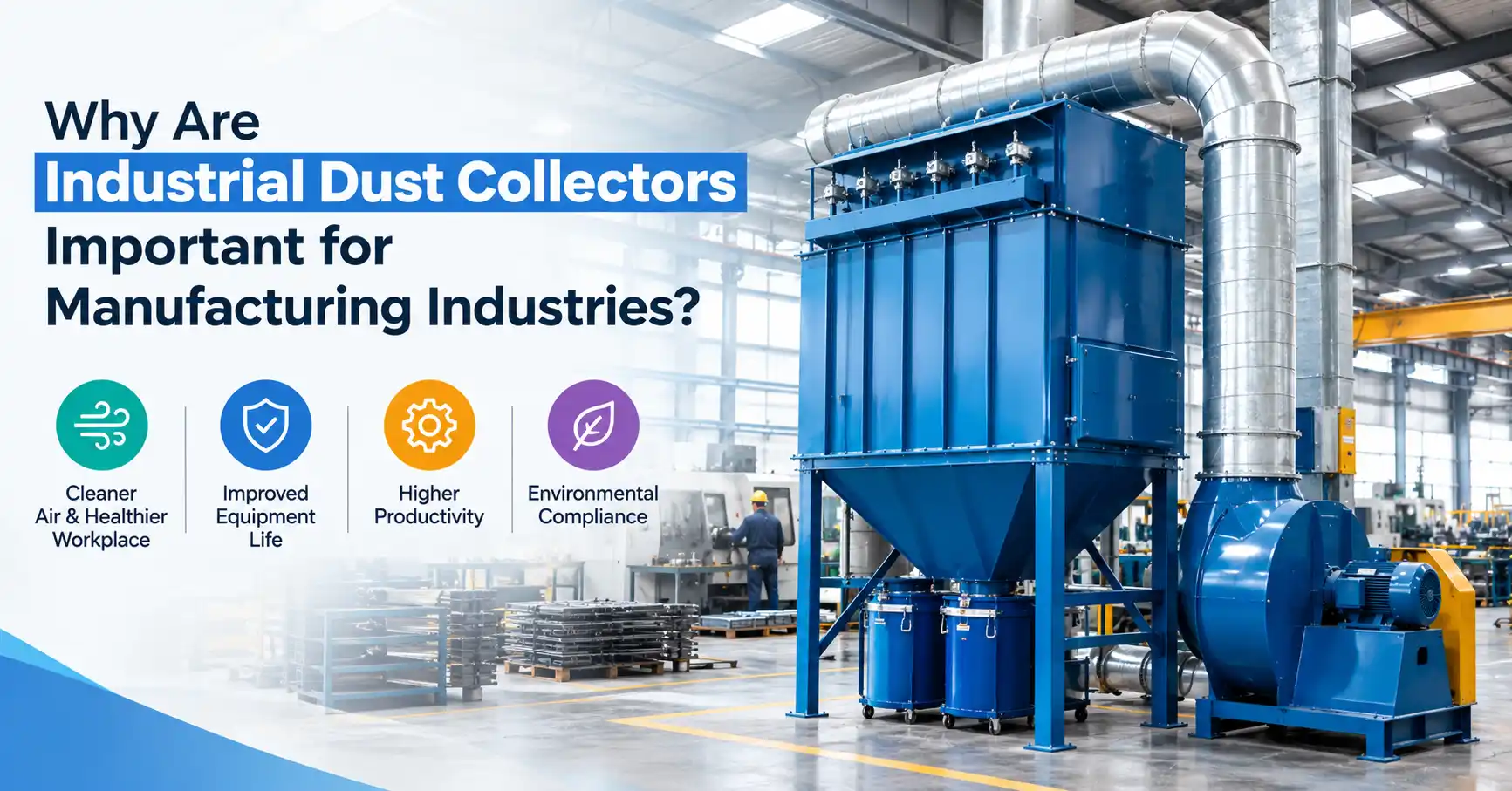
Manufacturing facilities generate dust, fumes, fine particles, and other airborne contaminants as part of everyday production. From metal grinding and woodworking to cement handling, pharmaceuticals, food processing, and plastics, these particles can affect workers, equipment, product quality, and compliance. That is why industrial dust collectors are an essential part of modern manufacturing: they capture airborne contaminants at or near the source and help maintain a cleaner, safer, and more productive workplace.

What Are Industrial Dust Collectors?
Industrial dust collectors are engineered air-filtration systems designed to remove dust and particulate matter from industrial air streams. Depending on the application, a system may use cartridge filters, baghouse filters, cyclone separators, wet scrubbers, or combinations of technologies.
Unlike simple room ventilation, a properly designed dust collection system for manufacturing industries captures contaminants before they spread throughout the facility. Source capture hoods, ductwork, fans, filters, and industrial dust collectors work together to separate particles from process air and return cleaner air to the workplace or exhaust it safely.
Why Industrial Dust Collectors Matter in Manufacturing
The importance of dust collectors in manufacturing becomes clear when you consider what uncontrolled airborne particles can do. Fine dust can settle on machinery, enter electrical components, contaminate products, and create housekeeping problems. Some combustible dusts can also present serious fire and explosion hazards when they accumulate or become suspended in air.
Effective dust control in manufacturing industries therefore supports more than workplace cleanliness. It can contribute to occupational health, process reliability, regulatory compliance, and safer production.
1. Protecting Worker Health
Long-term exposure to industrial dust can irritate the eyes, skin, and respiratory system. Local exhaust ventilation paired with high-efficiency filtration can reduce exposure where dust is generated.
This is one of the strongest reasons facilities invest in industrial dust collection systems. Instead of allowing contaminants to circulate through the workspace, the system removes them from process air and directs them toward controlled filtration and disposal.
2. Improving Product Quality
Dust is not only a health concern; it can also become a quality problem. In precision manufacturing, surface finishing, coating, electronics, food production, and pharmaceutical operations, unwanted particles may settle on components or enter sensitive processes.
A suitable dust collection system for manufacturing industries helps keep production environments cleaner and can reduce particle-related defects. Cleaner air is particularly valuable where consistent finishes, hygiene, or contamination control are critical.
3. Protecting Machinery and Production Equipment
Accumulated dust can clog filters, obstruct moving parts, coat motors, and interfere with sensors and electrical equipment. When deposits build up around machinery, maintenance requirements can increase and equipment life may be affected.
One of the practical industrial dust collector benefits is controlling where collected material goes. Instead of allowing dust to settle across a plant, the system transports it through dedicated ductwork into a collection point. This supports cleaner equipment and makes routine maintenance more manageable.
4. Reducing Fire and Explosion Risks
Certain industrial dusts—including some metal, wood, food, plastic, and chemical dusts—can become combustible under the right conditions. A facility should assess its specific materials and processes rather than assuming all dust behaves the same way.
Good dust control in manufacturing industries includes controlling accumulation, selecting suitable filtration equipment, managing ignition sources, and following applicable safety standards.
5. Supporting Regulatory and Environmental Compliance
Manufacturers operate under workplace safety and environmental requirements that can limit airborne emissions and employee exposure. A properly engineered collection system can help control process emissions and maintain documented operating conditions.
The importance of dust collectors in manufacturing is particularly evident when production involves hazardous or nuisance particulate matter. Proper filtration and airflow management help ensure that the system continues to perform as intended.
Explore More: Hydroseeder machine in delhi | multi utility vehicle in Odisha | dust suppression system in India
How Industrial Dust Collection Systems Work
A typical system begins at the dust-generating process. A hood or enclosure captures contaminated air, while a fan creates the airflow needed to move it through the duct network. The air then enters a separator or filter where particles are removed. Collected dust falls into a hopper, bin, drum, or other approved container.
System design matters as much as the collector itself. Duct diameter, airflow velocity, hood placement, fan selection, filter area, pressure drop, and material properties all influence performance. A poorly designed system may capture dust at one machine while leaving another area inadequately controlled.
The goal of industrial dust collection systems is therefore not simply to move dirty air. The complete system must capture contaminants efficiently, transport them safely, filter the air effectively, and manage collected material properly.
Choosing the Right Dust Collection System
Every manufacturing process has different contamination characteristics, so there is no universal collector for every plant. Before selecting equipment, engineers typically consider dust type and concentration, particle size, temperature, moisture, production rate, available space, and whether the material is combustible or hazardous.
The importance of dust collectors in manufacturing also depends on correct sizing and installation. Oversized equipment may waste energy and capital, while undersized equipment may struggle to maintain capture velocity.
For facilities comparing industrial dust collection systems, lifecycle cost is often more useful than purchase price alone. Filter replacement, energy use, cleaning requirements, downtime, maintenance access, and disposal costs can influence the total cost of ownership.
Key Industrial Dust Collector Benefits for Manufacturers
When the system is correctly engineered, the benefits extend across health, safety, operations, and maintenance. Cleaner production areas can improve housekeeping, reduce visible dust, and support more organized workflows.
Common industrial dust collector benefits include:
- Lower employee exposure to airborne particulate matter.
- Cleaner machinery, floors, and production spaces.
- Better control of process emissions and contamination.
- Reduced accumulation of potentially combustible dust.
- More predictable maintenance and improved equipment protection.
- Support for product quality and consistent manufacturing conditions.
A properly sized dust collection system for manufacturing industries should therefore be treated as production infrastructure rather than an optional add-on. Its performance can influence workplace conditions and manufacturing reliability.
Maintenance: The Key to Long-Term Performance
Even industrial dust collectors cannot perform effectively without regular inspection and maintenance. Filters need to be checked for damage and loading, ductwork should be inspected for leaks or buildup, and fans and motors should be maintained according to manufacturer recommendations.
Routine maintenance is a central part of dust control in manufacturing industries because collection efficiency can decline gradually without obvious warning. A preventive maintenance schedule helps identify problems before they become expensive production interruptions.
Why Investing in Dust Collection Is a Smart Manufacturing Decision
A cleaner work environment can support employee well-being, protect equipment, improve housekeeping, and help manufacturers meet operational and regulatory expectations.
Automeck is one example of a manufacturer that can be considered when evaluating engineered dust-management solutions, but the right choice should always be based on application requirements, engineering quality, service support, and total lifecycle performance.
Conclusion
For modern manufacturing facilities, industrial dust collectors play a critical role in controlling airborne particulate matter at its source. From protecting workers and machinery to supporting product quality, compliance, and safer operations, an appropriately designed system can deliver value across the production environment.
The best results come from treating collection as an engineered process: assess the dust, design effective source capture, select suitable filtration, size the fan and ductwork correctly, and maintain the system consistently. When these elements work together, manufacturers can create cleaner and more reliable workplaces without compromising production efficiency.
Frequently Asked Questions
1. What is the main purpose of a dust collector?
A dust collector captures airborne dust and particulate matter from industrial processes before contaminants spread through the workplace.
2. Which industries need dust collection?
Metalworking, woodworking, cement, food processing, pharmaceuticals, plastics, chemicals, and other industries can require dust collection depending on their processes.
3. Are all dust collectors the same?
No. Collector type and configuration depend on dust characteristics, airflow, temperature, hazard level, production volume, and filtration requirements.
4. How often should a dust collection system be maintained?
Inspection frequency depends on the application and equipment. Filters, ducts, fans, and collection containers should be checked regularly according to manufacturer recommendations.
5. Can dust collection improve manufacturing efficiency?
Yes. Effective collection can reduce cleanup, protect equipment, support consistent product quality, and reduce disruptions caused by dust accumulation.