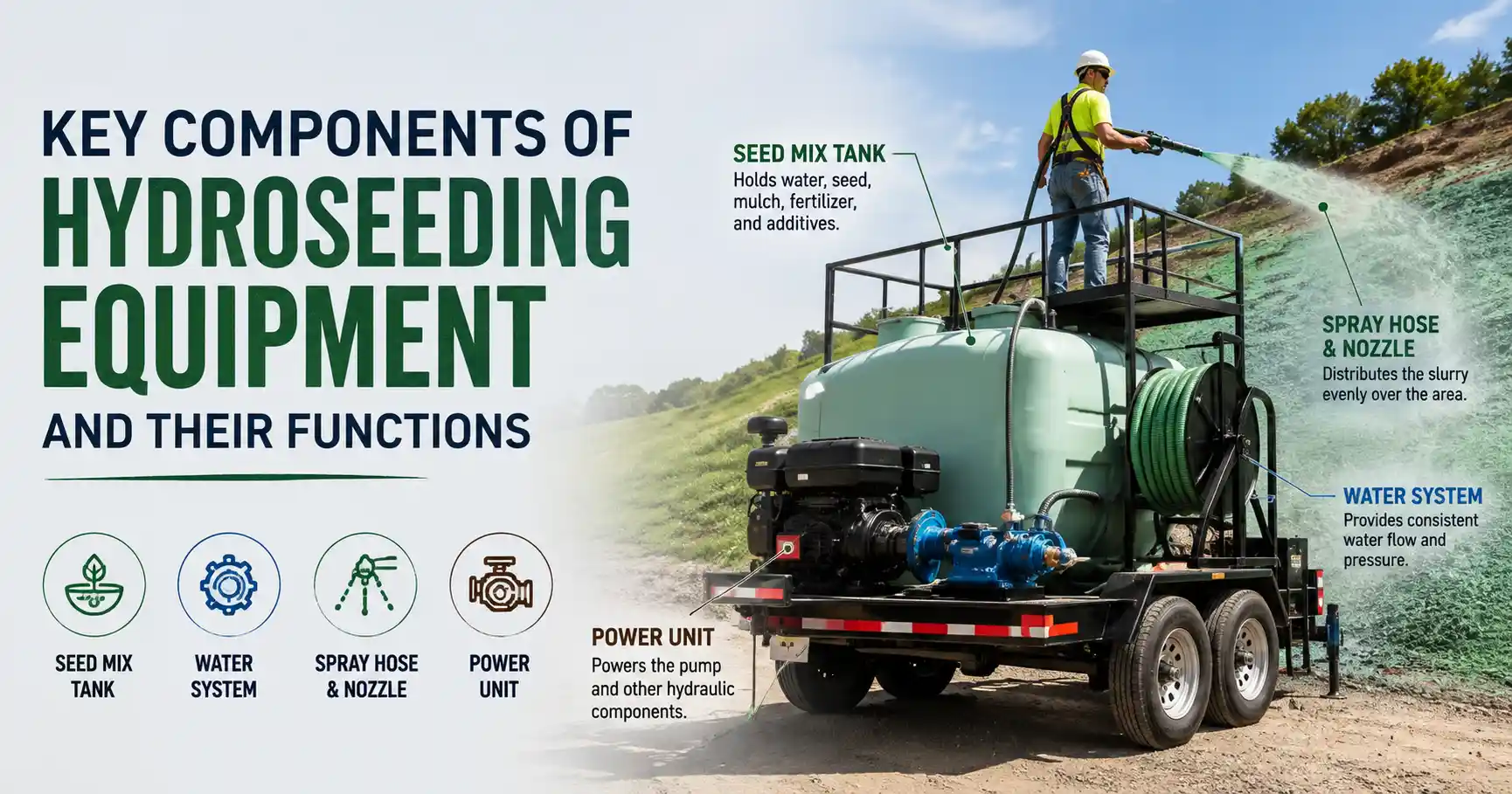
Hydroseeding is a fast and efficient method of establishing vegetation by spraying a slurry made from seed, water, fertilizer, mulch, and other amendments over prepared soil. Understanding the major hydroseeding equipment components is essential for choosing the right machine, maintaining consistent application, and achieving better grass and vegetation growth. From the mixing tank to the pump and spray nozzle, every part plays a specific role in turning raw materials into a uniform hydraulic seeding mixture.
Whether you are managing erosion control, landscaping, roadside revegetation, sports fields, or large-scale land restoration, knowing how a hydroseeder works can help improve productivity and application accuracy.

What Are Hydroseeding Equipment Components?
A hydroseeder is essentially a specialized mixing and spraying system. It combines water, seed, mulch, fertilizer, tackifiers, and other additives into a homogeneous slurry before applying it to the target surface. The machine must maintain the right balance between mixing performance, pumping capacity, pressure, and spray distribution.
The most important hydroseeding equipment parts are designed to work together rather than operate independently. A high-capacity tank is of little value without an appropriately sized pump, while a powerful pump cannot deliver good coverage if the agitation system fails to keep mulch and seed evenly suspended.
Different manufacturers offer machines with different tank capacities, pump configurations, engine options, and control systems. For example, equipment supplied by manufacturers such as Automeck can be configured for applications ranging from landscaping to erosion-control projects.
Key Hydroseeding Equipment Components and Their Functions
The performance of a hydroseeder depends on several interconnected components. Understanding each one makes it easier to identify suitable equipment for a particular project.
1. Mixing Tank
The mixing tank is the central container where water, seed, mulch, fertilizer, and additives are combined. Tanks are commonly manufactured from steel, stainless steel, or corrosion-resistant materials, depending on machine design and application.
Tank capacity determines how much slurry can be prepared in a single batch. Larger tanks are useful for commercial projects because they reduce the number of refills and can increase daily productivity.
The tank should also provide adequate internal space for circulation. Poor circulation can cause mulch, seed, or fertilizer to settle, resulting in an inconsistent mixture and uneven application.
2. Agitation System
The agitation system keeps the slurry moving inside the tank. It may use mechanical paddles, hydraulic agitation, or a combination of circulation methods.
Its primary function is to prevent heavier materials from settling at the bottom of the tank. Consistent agitation helps distribute seed, mulch fibers, fertilizer, and tackifiers throughout the mixture.
Agitation is particularly important when applying fiber mulch or dense slurry formulations. Without sufficient mixing action, the material may become too thick in some areas and too diluted in others.
3. Pump
The pump is responsible for moving the hydroseeding slurry from the tank through the discharge system and toward the application area. Pump selection directly affects spray distance, flow rate, pressure, and the ability to handle different slurry formulations.
Centrifugal pumps are commonly used because they can provide high flow rates and handle many hydroseeding applications efficiently. However, the ideal pump depends on the machine’s design and the required operating conditions.
Among the most important hydroseeding machine components, the pump deserves particular attention because an incorrectly matched pump can reduce application efficiency and increase wear.
4. Engine and Power Source
The engine supplies the mechanical power required to operate the pump and, depending on the machine, other hydraulic or mechanical systems.
Engine size should be matched to the pump capacity and overall machine configuration. An undersized power source may struggle under demanding operating conditions, while an unnecessarily large engine can increase fuel consumption and operating costs.
Routine inspection of belts, filters, oil levels, cooling systems, and other engine-related components helps maintain reliable performance.
5. Spray Nozzle and Discharge System
The discharge system transports slurry from the pump to the application point. It may include hoses, pipes, valves, spray guns, and nozzles.
The nozzle influences spray pattern, coverage width, flow, and application distance. Different nozzles may be selected depending on whether the operator is covering a small landscaped area or spraying a difficult-to-reach slope.
The discharge hose must also be appropriately sized for the slurry and operating pressure. Restrictions or blockages can reduce flow and negatively affect application consistency.
6. Control Valves and Pressure Controls
Control valves allow operators to regulate slurry flow and direct material through different discharge routes. Pressure controls help maintain suitable operating conditions during spraying.
These components give operators greater control over application speed and coverage. They can also make it easier to switch between different application methods, such as using a spray gun for targeted areas or a hose for longer-distance applications.
7. Loading and Filling System
The loading area is where raw materials enter the mixing tank. A practical loading system can make a major difference to productivity, especially on large projects requiring repeated batches.
A well-designed opening should provide enough access for adding mulch, seed, fertilizer, and soil amendments while minimizing spills. Some systems also incorporate features that simplify water filling and material handling.
Explore More: Car polishing service | Hydroseeder Components and Functions | Hydroseeder Truck Maintenance Checklist
How Hydroseeding Machine Components Work Together
The individual hydroseeding machine parts and functions become most effective when the complete system operates as a coordinated process.
First, water is added to the tank. Mulch, seed, fertilizer, tackifier, and other selected materials are then introduced according to the application requirements. The agitation system keeps these ingredients moving while they are blended into a consistent slurry.
Once the mixture reaches the desired consistency, the pump draws it from the tank and pushes it through the discharge system. The operator uses valves and spray equipment to control the direction and distribution of the slurry.
This coordinated process explains why hydroseeder components and functions should be evaluated as a complete system rather than as isolated parts. Tank capacity, agitation, pump performance, engine power, hose diameter, and nozzle configuration all influence the final result.
For example, a project involving steep slopes may require different pumping and discharge capabilities than a small residential lawn. Similarly, a thick fiber-mulch mixture may require stronger agitation and an appropriate pump configuration.
Understanding Hydroseeding Equipment Functions for Better Performance
Knowing the major hydroseeding equipment functions helps operators make better decisions about machine setup and maintenance. The objective is not simply to spray a mixture but to maintain uniform slurry quality from the beginning of the batch until the final application.
Several factors can influence performance:
- Slurry consistency: The mixture should remain sufficiently uniform to deliver seed, mulch, and amendments consistently.
- Pump and nozzle compatibility: Flow rate and pressure should suit the selected discharge equipment.
- Agitation performance: Continuous circulation helps prevent settling and improves material distribution.
- Application technique: Spray distance, nozzle angle, pressure, and operator movement affect coverage.
- Preventive maintenance: Cleaning tanks, hoses, pumps, valves, and nozzles after use reduces blockages and premature wear.
Correct operation can also reduce material waste. When the slurry is mixed properly and distributed evenly, operators can achieve more consistent coverage without repeatedly treating the same area.
Choosing the Right Hydroseeding Equipment Parts
Selecting the right hydroseeding equipment parts starts with understanding the intended application. A contractor working on commercial erosion-control projects may prioritize high tank capacity, strong pumping performance, and durable construction. A landscaping company may place greater emphasis on maneuverability, versatility, and ease of operation.
Important considerations include tank size, pump type, engine capacity, agitation method, spray range, hose configuration, nozzle options, and ease of cleaning.
Replacement parts should also match the original equipment specifications. Using an unsuitable hose, valve, nozzle, or pump component can affect system performance and may create unnecessary mechanical stress.
Maintenance of Hydroseeding Machine Components
Regular maintenance is one of the simplest ways to extend equipment life. After every application, the tank and slurry lines should be thoroughly flushed to remove residual mulch and other materials. Nozzles and strainers should be checked for blockages, while valves and hoses should be inspected for leaks or damage.
The pump should receive routine attention according to the manufacturer’s maintenance schedule. Engine oil, filters, belts, bearings, and other wear-prone components should also be inspected at appropriate intervals.
Operators should pay special attention to components that come into frequent contact with abrasive mulch fibers. Early detection of wear can prevent small problems from becoming costly downtime.
Why Understanding Hydroseeder Components and Functions Matters
Understanding hydroseeder components and functions allows operators, contractors, and equipment buyers to evaluate machines more effectively. Instead of focusing only on tank capacity or engine power, they can assess how the complete system will perform for their specific application.
A properly matched hydroseeder can improve productivity, simplify material handling, support consistent slurry distribution, and reduce unnecessary maintenance. It can also help operators adapt their application strategy to different soil conditions, slopes, seed mixes, and erosion-control requirements.
Ultimately, the best machine is not necessarily the largest one. It is the machine whose tank, pump, agitation, engine, discharge system, and controls are appropriately matched to the project’s requirements.
Conclusion
Understanding the key hydroseeding equipment components makes it easier to select, operate, and maintain a hydroseeder effectively. The mixing tank, agitation system, pump, engine, valves, hoses, nozzles, and loading system each perform an important function, but their real value comes from working together as one integrated application system.
For contractors and landscaping professionals, evaluating equipment according to project size, slurry formulation, spray distance, terrain, and maintenance requirements can lead to better productivity and more consistent vegetation establishment. With the right equipment configuration and proper operating practices, hydroseeding can provide an efficient solution for landscaping, revegetation, and erosion-control applications.
Frequently Asked Questions
What is the most important part of a hydroseeder?
The pump is critical because it moves the slurry through the discharge system, but overall performance depends on all major components working together.
What does the agitation system do?
It keeps seed, mulch, fertilizer, and additives suspended so the slurry remains reasonably uniform during application.
How often should a hydroseeder be cleaned?
The tank, hoses, pump, and nozzles should generally be flushed and cleaned after each use to reduce blockages and material buildup.
Can one hydroseeder handle different applications?
Yes. A suitable machine can be used for landscaping, erosion control, roadside revegetation, and other projects when its capacity and configuration match the application.
How do I choose the right hydroseeder?
Consider tank capacity, pump performance, agitation, spray range, engine power, terrain, slurry formulation, and the scale of your projects.