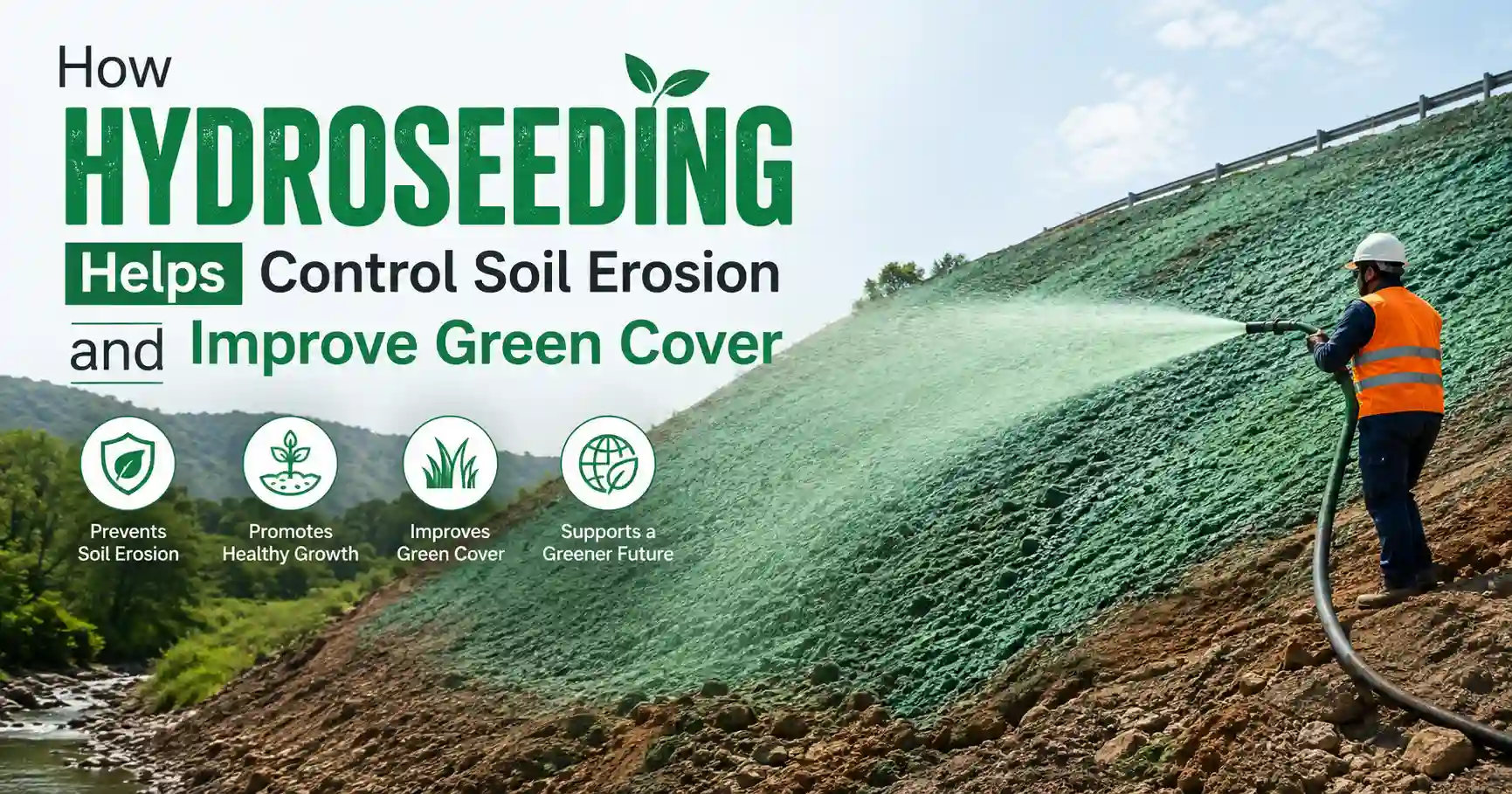
Soil erosion can quietly damage landscapes, reduce soil fertility, expose plant roots, and increase sediment runoff during heavy rain. One practical way to address these challenges is hydroseeding for soil erosion control, a vegetation establishment technique that combines seed, mulch, water, fertilizer, and other soil amendments into a slurry and sprays it evenly over prepared ground. By creating favorable conditions for rapid vegetation growth, hydroseeding helps stabilize exposed soil while supporting long-term green cover.
Unlike traditional broadcast seeding, hydroseeding distributes seed and protective materials uniformly across difficult or uneven surfaces. This makes it useful for construction sites, road embankments, slopes, disturbed land, parks, industrial areas, and ecological restoration projects where conventional planting methods may be slow or difficult.

What Is Hydroseeding and How Does It Work?
Hydroseeding is a mechanical seeding method in which a carefully prepared slurry is sprayed onto the target surface. The mixture generally contains grass or native plant seeds, water, wood fiber or cellulose mulch, fertilizer, and sometimes tackifiers or soil conditioners.
After application, the mulch forms a protective layer over the soil. It helps retain moisture, reduces the impact of raindrops, and creates a suitable microenvironment for seed germination. As vegetation develops, roots begin binding soil particles together, gradually improving soil structure and surface stability.
The process typically starts with site preparation. Loose debris, large rocks, and unwanted vegetation are removed, while severe compaction may be addressed through grading or soil preparation. Seeds and amendments are then selected according to soil conditions, climate, slope characteristics, and the desired vegetation.
Hydroseeding is particularly valuable where large areas need to be covered quickly. It can also reach slopes, roadside cuts, and other locations where manually spreading seed would require considerable labor.
Hydroseeding for Soil Erosion Control: Why It Works
The central advantage of hydroseeding for soil erosion control is that it combines immediate surface protection with long-term biological stabilization. Erosion is often accelerated when bare soil is exposed to rainfall and wind. Without vegetation, water can detach soil particles and carry them downslope, creating rills, gullies, and sediment runoff.
Hydroseeding addresses this problem in stages. The mulch layer provides initial protection, while germinating vegetation develops a living root network that strengthens the soil over time. This combination makes hydroseeding a useful component of erosion management strategies.
How hydroseeding prevents soil erosion
Understanding how hydroseeding prevents soil erosion starts with the relationship between rainfall, soil particles, and vegetation. Bare soil absorbs the direct force of raindrops, which can break apart soil aggregates. When water begins flowing across the surface, these loosened particles can be transported away.
The hydroseeding mulch acts as a temporary protective cover. It reduces direct raindrop impact and slows surface water movement. As seeds germinate, stems and leaves provide additional surface coverage, while roots create physical connections between soil particles.
This vegetation-based approach can reduce runoff velocity and improve water infiltration, depending on soil type, slope, rainfall, and site conditions. For steeper or highly vulnerable sites, hydroseeding may be combined with erosion-control blankets, wattles, drainage systems, terracing, or other engineered measures.
Hydroseeding for Erosion Control on Challenging Landscapes
Hydroseeding for erosion control is especially useful on landscapes where conventional seeding or planting is difficult. Sloped construction sites, highway embankments, mining areas, drainage channels, and large disturbed surfaces often require fast and consistent vegetation establishment.
Because the slurry can be sprayed over large areas, application is relatively uniform when performed correctly. The mulch also helps hold seeds in place, reducing the likelihood that seeds will be displaced before germination.
Site-specific planning remains important. Seed selection should consider native species, seasonal conditions, soil characteristics, sunlight, moisture availability, and the intended purpose of the vegetation. A slope designed for long-term stabilization may require a different seed mixture from a roadside landscape or ecological restoration site.
Professional application can further improve results by ensuring appropriate slurry composition, spray coverage, and post-application maintenance.
Explore More: Automatic Wheel Washing System | Dust Collection System in Andhra Pradesh | Industrial Pollution Control
Key Hydroseeding Benefits for Soil Erosion
The hydroseeding benefits for soil erosion extend beyond simply covering bare ground. A successful application can support both immediate erosion mitigation and longer-term landscape recovery.
Two important benefits include:
- Rapid surface coverage: Hydroseeding can establish vegetation across broad areas more efficiently than many manual planting approaches, helping reduce the period during which soil remains exposed.
- Improved soil stability: Growing roots bind soil particles, while above-ground vegetation slows rainfall and surface runoff. Together, these effects can support stronger and more resilient ground cover.
Hydroseeding can also help improve moisture retention through its mulch component. Better moisture conditions can support seed germination and early plant development, particularly when the application is followed by suitable irrigation and maintenance.
However, hydroseeding is not a standalone solution for every erosion problem. Severe slopes, concentrated water flow, unstable soils, and areas exposed to extreme weather may require additional structural or biodegradable erosion-control measures.
Hydroseeding to Improve Green Cover and Restore Disturbed Land
Healthy vegetation is one of the most effective natural tools for protecting soil. Hydroseeding to improve green cover can help transform exposed or degraded surfaces into vegetated landscapes by introducing seeds and protective amendments in a single application.
Green cover provides several environmental benefits. Plants intercept rainfall, reduce surface runoff, contribute organic matter, support soil organisms, and create habitats for insects and other organisms. Vegetation can also improve the visual appearance of construction and infrastructure sites.
For land restoration, choosing suitable plant species is critical. Native grasses, groundcovers, legumes, and other locally adapted species can be incorporated where appropriate. Species diversity can improve ecological value and may create a more resilient plant community than relying on a single grass variety.
Projects that focus on hydroseeding to improve green cover should also consider what happens after germination. Irrigation, mowing, weed management, soil fertility, and protection from disturbance may all influence whether the vegetation becomes established and sustainable.
Hydroseeding for Vegetation Restoration
Disturbed land often loses its natural vegetation because of construction, excavation, development, fire, intensive use, or other environmental pressures. Hydroseeding for vegetation restoration provides a practical method for reintroducing plant life across large or inaccessible areas.
Restoration projects may use carefully selected native seeds to support biodiversity and recreate vegetation communities suited to local environmental conditions. In some cases, hydroseeding can complement erosion-control fabrics, compost amendments, topsoil replacement, and other restoration practices.
The ecological goal should go beyond achieving a green appearance. A well-planned restoration project considers soil health, plant diversity, habitat value, water availability, and long-term maintenance. When these factors are addressed together, vegetation can become an active part of the landscape’s erosion-resistance system.
For commercial and infrastructure projects, specialized hydroseeding equipment can improve application efficiency and consistency. Companies such as Automeck can support projects where suitable hydroseeding machinery is required for large-scale vegetation establishment.
Factors That Influence Hydroseeding Results
Hydroseeding performance depends on more than the application itself. Soil preparation, seed quality, climate, water availability, slope, mulch selection, and aftercare all influence germination and establishment.
The timing of application is also important. Applying seed during a suitable growing period gives plants a better opportunity to establish strong roots before facing extreme heat, cold, or heavy rainfall.
After application, the area should generally be protected from unnecessary traffic and erosion. Appropriate watering helps maintain moisture during germination, while monitoring allows problems such as seed displacement, washouts, weed competition, or poor germination to be addressed early.
When hydroseeding is integrated into a broader erosion-control and landscape-management plan, it can provide a balance between immediate surface protection and sustainable vegetation growth.
Conclusion
Hydroseeding for soil erosion control offers a practical way to protect exposed soil while encouraging fast, uniform vegetation establishment. Its combination of seed, mulch, water, and soil amendments helps shield the surface during early growth, while developing roots provide longer-term soil stabilization.
From construction slopes and roadside embankments to degraded landscapes, hydroseeding can support erosion management, landscape rehabilitation, and sustainable vegetation establishment. The best results come from selecting suitable plant species, preparing the soil correctly, applying the slurry uniformly, and providing appropriate aftercare.
When planned according to site conditions, hydroseeding can be more than a method of planting seed. It can become an important part of a broader strategy for restoring disturbed land, reducing runoff, protecting soil resources, and creating healthier green landscapes.
Frequently Asked Questions
What is hydroseeding?
Hydroseeding is a planting method that sprays a slurry of seed, mulch, water, and other amendments over prepared soil.
Is hydroseeding effective on slopes?
Yes. It is particularly useful on slopes because mulch helps hold seed in place while vegetation develops roots that stabilize the soil.
How quickly does hydroseeding grow?
Germination can begin within days to weeks, depending on seed species, temperature, moisture, soil conditions, and maintenance.
Can hydroseeding be used for land restoration?
Yes. It can support vegetation restoration on construction sites, degraded land, embankments, and other disturbed areas.
Does hydroseeding eliminate soil erosion?
Not always. It can significantly support erosion management, but severely unstable or steep sites may require additional erosion-control measures.